Having assistants doesn’t mean having clients
A webinar can end with a screen full of names, hundreds of connected attendees, and excellent participation. The team can leave satisfied, thinking the event was a success.
But the next day a much more important question arises:
How many sales did the webinar actually generate?
This is one of the differences between organizing a digital event and using a webinar as a marketing and sales tool. Gaining registrations and attendees is important, but the real value emerges when some of that audience moves toward a sales conversation, a demonstration, a consultation, or a purchase.
A webinar shouldn’t be designed solely to teach something. It should be part of a journey where the content helps the potential client understand their problem, discover possible solutions, and feel ready to take the next step.
Therefore, turning a webinar into sales requires much more than adding a call to action at the end of the presentation.
The conversion process begins long before the webinar
Many companies only start thinking about selling when there are five minutes left in the event. By then, it may be too late.
The conversion strategy should begin with defining the topic.
If the content attracts people who will never be interested in the company’s products or services, it will be difficult to convert them into customers, even if the webinar is excellent.
Conversely, when the topic is directly related to a problem that the company can solve, each stage of the event can bring the participant closer to a possible solution.
For example, a webinar on “How to Improve the Efficiency of Your Business Processes” can attract managers who are already experiencing problems with productivity, tracking, or customer management. If the company offers CRM and automation solutions, there’s a natural connection between the educational content and its business proposition.
The key is that the webinar must attract an audience that has a need related to what you can offer .
Educate first, sell later
One of the most common mistakes in sales webinars is trying to sell too early.
When someone signs up to learn, they expect to receive useful information. If the first few minutes turn into a sales pitch, trust quickly wanes.
A conversion-oriented webinar must strike a balance between education and business.
The content should help participants better understand their problem, show them why certain solutions work, and explain what mistakes they should avoid. As the audience understands the problem, they also begin to recognize the value of a professional solution.
The sale then ceases to feel like an interruption.
It becomes the next logical step.
The content should lead to a solution.
Not everything presented during a webinar has the same purpose.
Some parts are designed to generate knowledge. Others help demonstrate expertise. And others prepare the participant to consider a solution.
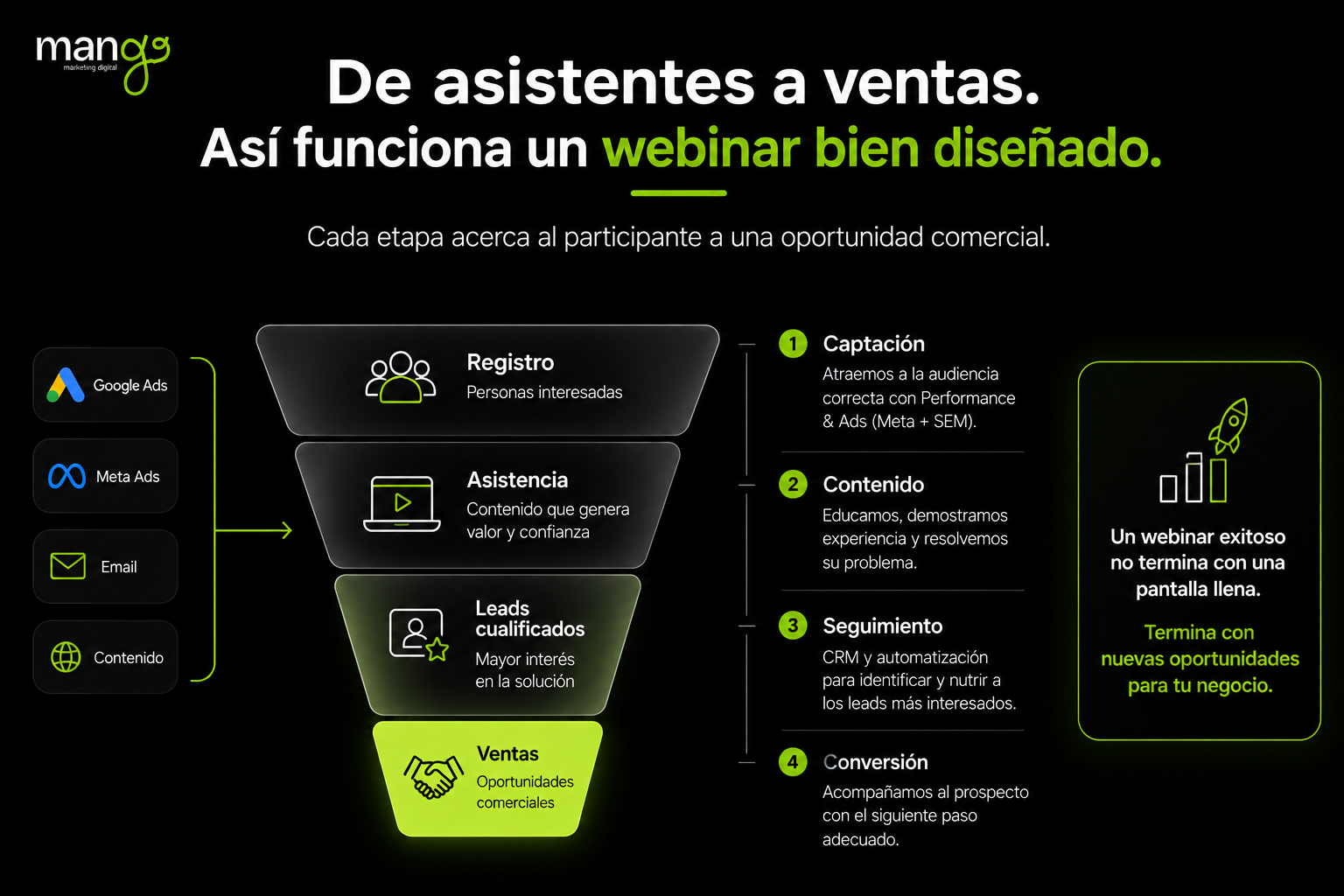
An effective structure can begin by explaining the problem, continue by showing its consequences, and then present different approaches to solving it.
For example, if the webinar is about lead generation, it can explain why getting traffic doesn’t guarantee conversions, what factors affect lead quality, and how to optimize the sales process.
After that journey, presenting a solution related to the problem feels much more natural.
The goal is not to hide the existence of an offer. It’s to create enough context for the participant to understand why that offer might be relevant to them .
A good offer needs a clear call to action
Even when the content has been excellent, many webinars miss opportunities because they never clearly explain what the participant should do next.
An effective call to action must be specific.
This may involve requesting a consultation, booking a demonstration, downloading a resource, requesting an audit, or speaking with a specialist.
The important thing is that the next step is simple and directly related to the problem that has just been addressed.
It’s also advisable to avoid presenting too many options at once. If the participant has five different actions available, they might not choose any of them.
A single main action and a clear value proposition usually make conversion much easier.
Not all attendees are ready to buy
Another important point is to understand that attendees are at different stages of the buying process.
Some may be looking for information for the first time. Others are already familiar with the problem and are comparing solutions. And some will be ready to talk to a provider.
Treating everyone the same way can make the strategy less effective.
A participant who has just discovered the problem likely needs more educational content. In contrast, someone who stayed for the entire webinar, interacted with the speaker, and asked for information may be much closer to making a decision.
Therefore, conversion does not always mean making a sale immediately.
In many cases, the intermediate goal is to identify the level of intention and offer each person the appropriate next step.
Follow-up turns interest into real opportunities
The end of the webinar is not the end of the sales process.
In fact, for many businesses, this is when the most important part begins.
A person may be interested during the event but not feel ready to buy at that moment. If they don’t receive any follow-up afterward, they may end up forgetting about the company or looking for an alternative.
Subsequent emails can summarize the main points of the webinar, share additional resources, answer frequently asked questions, and outline the next action.
Different messages can also be used depending on the behavior of each participant.
Those who did not attend can receive the recording. Those who attended can receive related resources. And those who showed a clear business interest can receive an invitation to speak directly with the team.
This type of tracking is much more effective when supported by automation processes.
CRM and automation make the conversion process scalable
When a webinar generates hundreds of leads, manually tracking all of this becomes complicated.
This is where a CRM and automation ecosystem can transform the process.
The CRM can record who registered, who attended, what actions they took, and their level of interest. Based on this information, it’s possible to create different communication flows and prioritize leads with the greatest sales potential.
This allows marketing and sales to work with the same information.
Instead of sending the same email to all participants, the company can develop more relevant and personalized conversations.
Automation does not replace human interaction.
It allows the sales team to dedicate more time to conversations that truly need human intervention.
Advertising also influences conversion
The conversion rate of a webinar does not depend exclusively on what happens during the event.
The quality of the attendees is directly related to the strategy used to attract them.
A well-segmented campaign may get fewer sign-ups than a mass campaign, but it can generate a much more qualified audience. And a qualified audience is more likely to become a sales opportunity.
Therefore, combining the webinar with a Performance & Ads strategy (Meta + SEM) allows you to work on different stages of the journey: attracting new audiences, generating interest, recovering visitors through remarketing, and directing traffic towards an experience designed to convert.
Advertising attracts attention.
The webinar builds trust.
Tracking drives conversion.
How to measure if the webinar is actually generating sales?
The number of attendees is a useful metric, but not a sufficient one.
To understand the true performance of the event, we need to analyze what happens afterwards.
How many attendees requested information?
How many booked a meeting?
How many turned into business opportunities?
How many sales were generated?
How much revenue did the event generate in relation to the investment made?
These metrics allow us to move from an evaluation based on popularity to an evaluation based on results.
A webinar with 1,000 attendees may be less profitable than one with 150 participants if those 150 have a much higher purchase intent.
The quality of the opportunities matters more than the size of the audience.
At Mango, we turn webinars into business opportunities
At Mango, we understand that a webinar shouldn’t end with a simple “thank you for attending” message .
Our Webinars & Digital Events service connects strategy, promotion, digital experience, automation, tracking and measurement to turn online events into real opportunity generation tools.
From data collection to follow-up, each stage must have a clear purpose.
Because the goal is not simply to gain an audience.
It’s about getting that audience to move forward.
Conclusion: A successful webinar moves the client forward
A webinar can educate, build trust, and position a company as a leader. But when it’s part of a well-designed business strategy, it can also become a constant source of business opportunities.
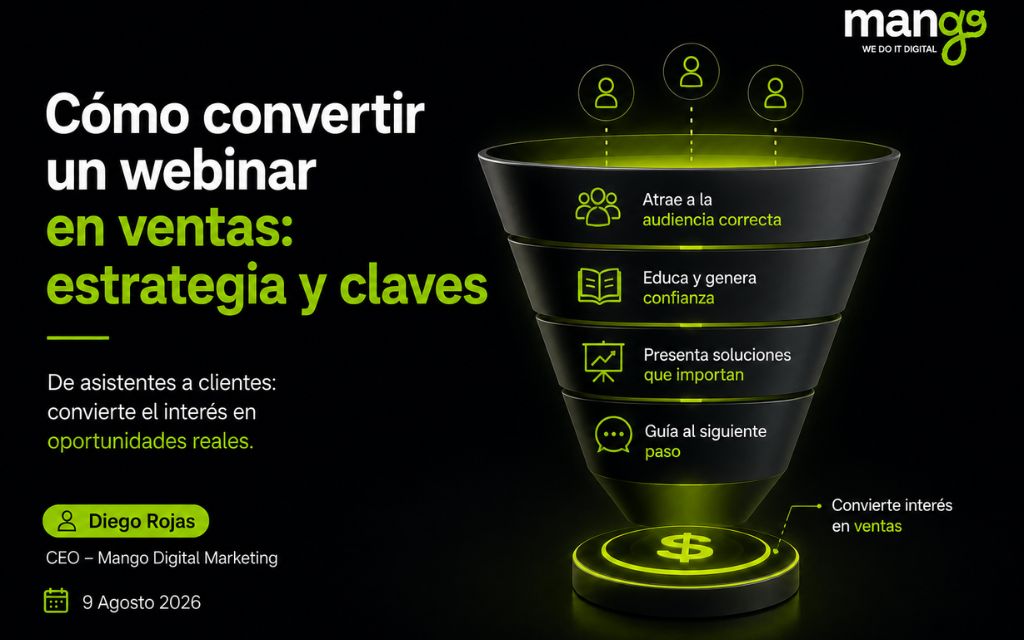
The key is to connect all the stages: attract the right audience, offer relevant content, present a solution at the right time, facilitate a clear action, and maintain contact after the event.
Not all attendees will become customers immediately.
But each interaction can bring them a little closer to a decision.
👉Want to turn your webinars into a real source of business opportunities? Discover how Webinars & Digital Events can help you design a complete strategy, from lead generation to conversion.