
The Illusion of Control
In today’s business ecosystem, information is the most valuable asset, but only if it’s actionable. Many companies operate under the “Illusion of Control”: they believe that because they have a spreadsheet with thousands of contacts and a “status” column, their business process is under control.
However, data management research shows that this fragmentation has a direct financial cost. If your sales team still relies on spreadsheets, scattered emails, and mental notes, you’re not managing customers; you’re managing chaos. This reality impacts customer management and limits growth.
Dirty Data and Operational Paralysis
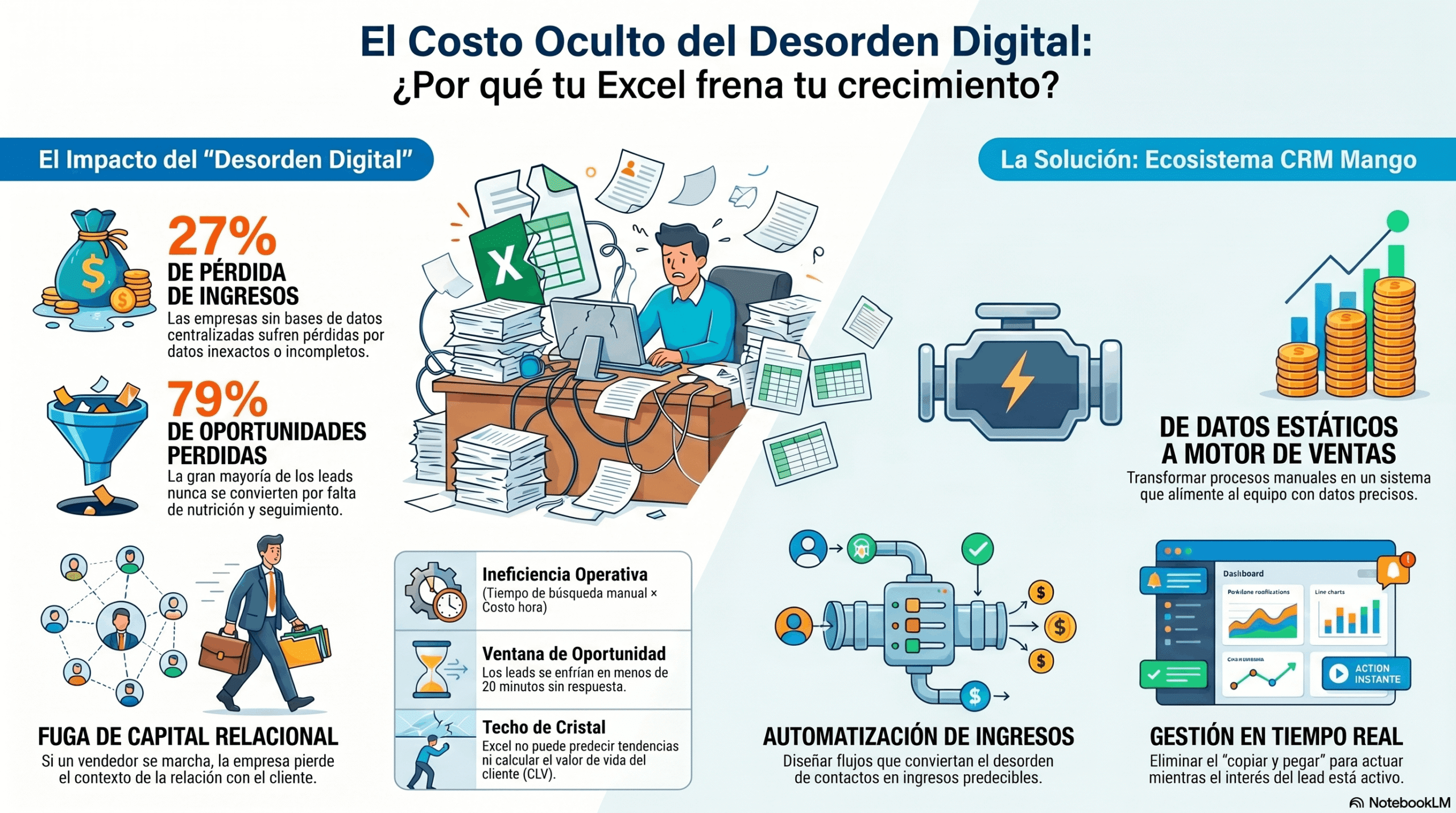
“Digital clutter” is not just an aesthetic problem. Recent studies indicate that companies without a centralized database can suffer revenue losses of up to 27% due to inaccurate or incomplete information. These are some of the main costs of poor data management .
When information lives in silos (one salesperson’s Excel spreadsheet, another’s WhatsApp), the company loses its institutional memory. If a key salesperson leaves, they take not only contacts but also the context of the relationship. This generates “Relational Capital Loss” and increases lead churn .
The Waste Equation
[Loss of Revenue] = (Manual search time × Hourly cost) + Opportunities lost due to lack of follow-up.
Research indicates that 79% of sales opportunities never convert into revenue due to a lack of nurturing and systematic follow-up. Without an automated platform, the human brain prioritizes the urgent over the important.
Why Excel is the “Glass Ceiling” of Your Company
Lack of Immediacy: A lead from your website can go cold in less than 20 minutes. If someone has to copy and paste the information into an Excel spreadsheet, lead loss increases.
Inability to Analyze: You cannot predict sales trends or calculate customer lifetime value (CLV) with static cells. Nor can you achieve true operational efficiency .
Security: Data in spreadsheets is vulnerable, easy to duplicate, and difficult to audit.
Mango’s CRM Ecosystem
At Mango, we understand that moving from manual processes to a structured ecosystem not only organizes operations but also unlocks growth potential. CRM implementation is a key step in the digitalization of businesses .
Implementing a CRM isn’t just about “buying software”; it’s about building an engine that feeds your team accurate data at the right time. Combined with sales automation , it allows you to optimize processes, strengthen customer management , and improve operational efficiency .
Do you feel like your team is working for the spreadsheet instead of letting the data work for them? We design CRM and sales automation implementation ecosystems that transform clutter into revenue.