The Dark Side of Technology
After understanding the cost of not having a system in our previous article, you might be tempted to rush out and buy the most expensive software license on the market. Stop.
There’s a statistic that terrifies managers: between 60% and 70% of CRM implementations fail to meet their original objectives. This failure is usually not due to coding or server errors; it’s a failure of strategic vision. In many cases, it’s a clear example of enterprise software failure caused by poor planning and execution.
The Implementation Triad: People, Processes, and Technology
Academic research emphasizes that CRM is a business philosophy, not a product. The fundamental error of the “70% Trap” is trying to solve a process or people problem by injecting technology.
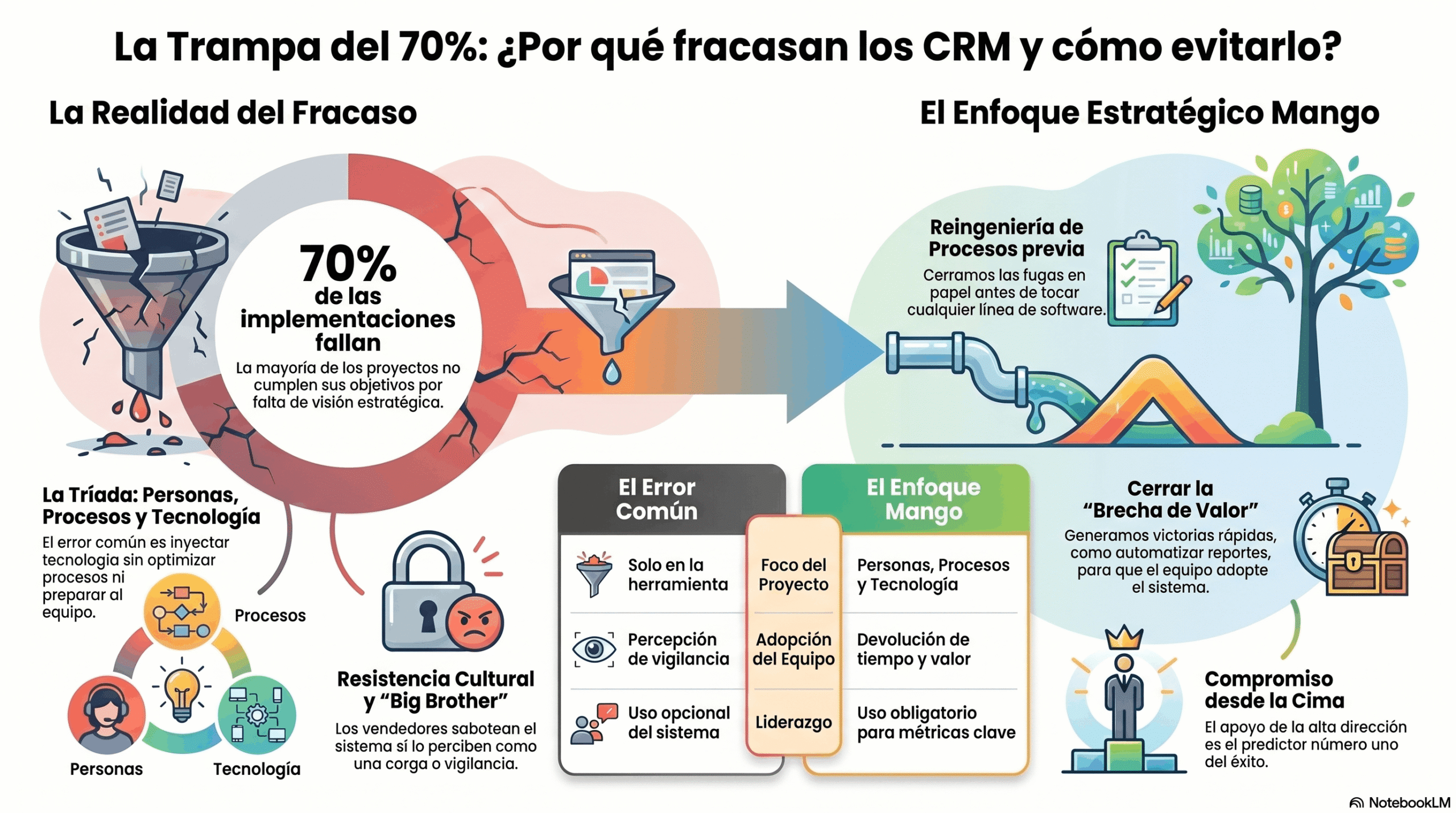
If you automate a process that is already inefficient, all you achieve is making the process fail faster.
Therefore, an effective CRM business strategy must balance people, processes, and technology to ensure sustainable results.
The 3 Pillars of Failure (and how to avoid them)
The Magic Tool Fallacy
Believing that the software will “set itself up” or that salespeople will magically love it is a common misconception. At Mango, our CRM consulting begins with a preliminary process re-engineering: if your sales pipeline has leaks, we close them on paper before even touching the software.
Cultural Resistance (The Human Factor)
CRM is often perceived by the sales team as a surveillance tool (“Big Brother”).
If the salesperson feels the system is an administrative burden rather than a sales tool, they’ll enter irrelevant data or sabotage adoption. Successful implementation requires managing change from a psychological perspective, not just a technical one.
Resistance to change is one of the biggest obstacles in any digital transformation process , so proper change management is essential to achieve system adoption.
Lack of Support at the Top
If the CEO or Sales Manager doesn’t use the CRM to review metrics, the team will perceive the system as optional. Research shows that senior management commitment is the number one predictor of success.
The Mango Approach: The “Value Gap”
Our methodology focuses on closing the “Value Gap.” We ensure the system delivers a quick win for the team (e.g., automating reports that previously took them 4 hours on Fridays).
When the team sees that the CRM saves them time and helps them close deals faster, adoption becomes second nature. This approach accelerates successful system implementation and maximizes return on investment.
Conclusion
Don’t let your company become another statistic of failure. CRM is the most powerful asset of a modern organization, provided it’s implemented by an expert who understands that technology should serve people, not the other way around.
A specialized CRM consultancy can make the difference between an abandoned project and a true digital transformation initiative capable of generating sustainable growth.
Have you tried implementing a CRM and it fizzled out? Or are you afraid to take the plunge because of past experiences? Secure your investment with a strategic assessment.
👉 Let’s make your CRM really work:
https://mangodm.com/ecosistemas-crm-automatizacion/